Guide
The consumer unit does not last forever. Here is how to tell when it is time to replace one, and what the practical difference is between an old board and a modern one.
If your fuse box uses rewireable fuse wire rather than miniature circuit breakers (MCBs), it is an old installation — typically from the 1970s or earlier. Rewireable fuses offer significantly less protection than modern MCBs and are almost always found in boards with no RCD protection at all.
A board with rewireable fuses will typically receive a C2 observation on an EICR — potentially dangerous — making the outcome unsatisfactory and requiring remedial action.
A residual current device (RCD) monitors the current flowing through a circuit and disconnects it in milliseconds if a fault is detected. Current standards require RCD protection on most domestic circuits. Many older consumer units either have no RCD at all, or only a single RCD protecting some circuits. Replacing the consumer unit with a modern dual-RCD or RCBO board resolves this.
If an EICR has identified the consumer unit as requiring replacement — coded C1 or C2 — it needs to be replaced. For landlords, this must be completed within 28 days of an unsatisfactory inspection (or sooner if specified in the report).
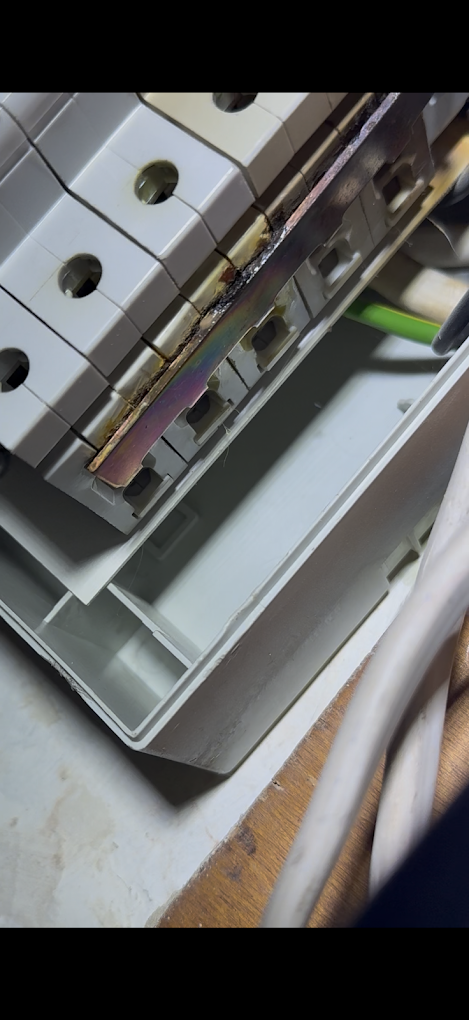
Visible burn marks, scorch damage, or significant discolouration at the consumer unit are serious warning signs indicating overheating due to loose or corroded connections. A board showing this kind of damage is typically coded C1 in an EICR — danger present. If you can see burn marks or smell burning near your fuse box, do not leave it unattended.
A consumer unit that was adequate when installed may now be full, with no room to add circuits for additional sockets, EV chargers, or outbuildings. An overcrowded board with no capacity is a practical reason to replace it.
Since 2016, consumer units installed in domestic properties in England and Wales are required to have metal enclosures rather than plastic ones. Existing plastic units are not automatically required to be replaced, but if a board is being replaced for any other reason, the replacement must be metal-clad.
A consumer unit replacement addresses the distribution board and the protective devices within it. It does not change the condition of the cables feeding into it. If the wiring itself is also old or deteriorated, an EICR will give you a clear picture of both and indicate which needs to be addressed. If both need attention, we may recommend a rewire alongside the board replacement.
Think your consumer unit needs replacing?
London BS Ltd carries out consumer unit replacements across Dunstable and the surrounding area. We will advise on what is needed before any work begins.
Consumer Unit Upgrades